Dr. Michael Pikos - "Zygomatic Implant Therapy Demystified: Hybrid vs Quad"
Episode summary
In this ZAGA Centers Podcast episode, Dr. Michael Pikos, a Tampa-based oral surgeon and educator with 41 years in practice, 35 years teaching at the Pikos Institute, and nearly 7,000 alumni across all 50 U.S. states and 67 countries, previews his Edentulism Conference 2025 session titled 'Zygomatic Implant Therapy Demystified: Hybrid versus Quad.' Pikos distinguishes the quad zygoma protocol, requiring advanced surgical skill and reserved for a finite number of clinicians, from the hybrid zygoma case, two single zygomatic implants plus premaxillary implants, suitable for most patients. He warns against a 'hammer and nail' mindset and social-media FOMO, stressing patient selection, morbidity awareness, and the trifecta of oroantral communication, sinusitis, and dehiscence. He credits Dr. Carlos Aparicio and endorses remote-anchorage options including pterygoid, trans-sinus, and paranasal implants.
Key takeaways
- Dr. Michael Pikos has 41 years in dental practice and 35 years as an educator at the Pikos Institute, with almost 7,000 alumni across all 50 U.S. states and 67 countries, and reports having placed roughly 36,000 implants and completed over 1,600 lateral wall sinus grafts.
- Pikos draws a sharp distinction between the quad zygoma case (four zygomatic implants), which demands specialized surgical skill and experience and is appropriate only for a finite number of clinicians globally, and the hybrid zygoma case (two single zygomatic implants plus two or ideally three premaxillary implants).
- Pikos estimates that 95 percent or more of course attendees will never perform a quad zygoma procedure, and argues that this is acceptable so long as clinicians can confidently place a single zygomatic implant while managing its associated morbidity.
- Moving from a single/hybrid zygoma case to a quad zygoma case is described as a 'quantum leap' in required skill; being able to do a single does not mean a clinician can safely do a quad.
- The 'dreaded trifecta' of complications, oroantral communication, sinusitis, and dehiscence, can occur regardless of skill level, so the key differentiator is the clinician's ability to manage them surgically and psychologically.
- Remote anchorage options including pterygoid, trans-sinus, and paranasal implants can reduce reliance on zygomatic implants and lower overall morbidity, but they still require advanced training and lack the long-term peer-reviewed data that zygomatic implants have accumulated.
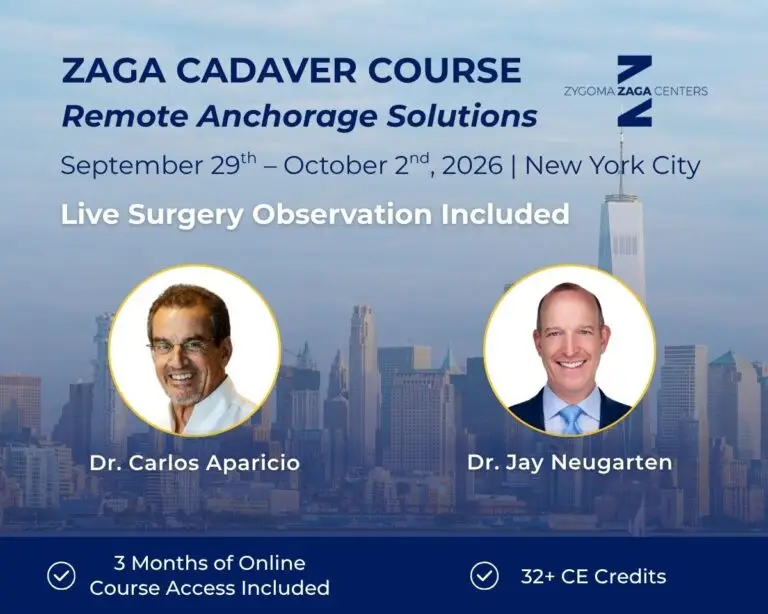
- Pikos credits Dr. Carlos Aparicio as a pioneer, having taken his ZAGA course twice in Barcelona, hosted him in Tampa, and co-run the first ZAGA course in North America (a cadaver course in Tampa), and endorses the ZAGA concept's customized radiographic and model workup.
What you'll learn
- Hybrid vs quad zygomatic implant configurations
- Patient-selection criteria for each approach
- Managing the severely atrophic maxilla
- Planning and predictability in complex full-arch cases
- When to add pterygoid anchorage
About the guest
Dr. Michael A. Pikos
Dr. Michael A. Pikos is an American oral and maxillofacial surgeon and a globally recognized implant educator. He is the founder and CEO of Coastal Jaw Surgery in the Tampa Bay area of Florida and founder/CEO of the Pikos Institute, where he has taught advanced bone and soft-tissue grafting and implant courses since 1990 to more than 7,000 alumni across all 50 U.S. states and 70-plus countries. His practice, Coastal Jaw Surgery, is the first ZAGA Center in Tampa Bay.
Credentials: DDS (Ohio State University); OMFS residency, University of Pittsburgh; Diplomate of the American Board of Oral and Maxillofacial Surgery; Diplomate of the American Board of Oral Implantology/Implant Dentistry; Diplomate of the ICOI; Diplomate of the American Academy of Osseointegration
ZAGA profile · coastaljaw.com · pikosinstitute.com · Wikipedia