Dr. Jay Neugarten, Speaker at Edentulism2023
Episode summary
Dr. Jay Neugarten, a New York oral and maxillofacial surgeon with 23 years in implant reconstruction and an early adopter of zygomatic implants, previews his two Edentulism2023 sessions on complications in treating edentulous patients. He stresses patient-specific diagnosis of age, comorbidities, periodontal status, and genetic factors before choosing among single implants, all-on-X, zygomatic, pterygoid, or nasalis solutions, warning against over-indicated all-on-X in dentate patients. He reports that 65-70% of his zygomatic cases follow failed maxillary reconstructions, nearly half within five years, and that zygomatic surgery is extra-maxillary, orthopedic-scale work near the orbit, brain, and infratemporal fossa. Citing published 97-98% success, he classifies complications as early, mid, and late, with infection most common, and insists on team-based management with ENT and restorative colleagues. His companion Saturday session addresses rehabilitating patients who have lost implants, including geriatric cases.
Key takeaways
- Dr. Jay Neugarten is an oral and maxillofacial surgeon practicing in New York City with 23 years in implant reconstruction, and was an early adopter of zygomatic implants in the early 2000s.
- He reports that 65-70% of his zygomatic implant cases are patients who have had failed maxillary reconstructions, with nearly 50% of those failing within the first five years of treatment.
- He cites published zygomatic implant success rates of 97-98%, framing the clinical challenge as how to manage the remaining 2-3% of cases with complications.
- Zygomatic complications are classified as early, mid, and late, with infection the most common; other risks include bleeding, implant malpositioning into the orbit, brain, or infratemporal fossa, and prosthetic failure through the palate.
- Zygomatic implants are extra-maxillary devices, 30 to 60 millimeters long, behaving more like an orthopedic device in non-tooth-bearing bone than a dental implant.
- Complication management is team-based, often requiring an ENT and close coordination with the restorative dentist.
- Complete diagnosis of the patient's age, comorbidities, periodontal and soft-tissue status must precede treatment choice, and over-indicating all-on-X in dentate patients who could retain their teeth is a recurring error.
What you'll learn
- Why complete diagnosis of comorbidities must precede any all-on-X or zygomatic decision
- The risk of over-indicating all-on-X in dentate patients who could keep their teeth
- Early, mid, and late zygomatic complications (infection, bleeding, malpositioning, prosthetic failure)
- Why 65-70% of the surgeon's zygomatic cases follow failed maxillary reconstructions, many within 5 years
- Team-based complication management involving ENT and restorative colleagues
- Treatment planning for geriatric patients where conservatism and reparability are paramount
About the guest
Dr. Jay Neugarten
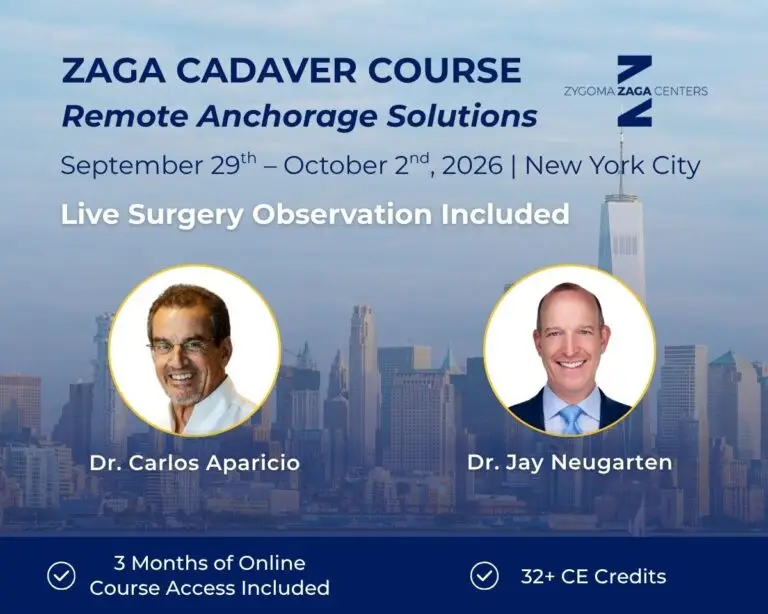
Dr. Jay Neugarten (DDS, MD, FACS) is an oral and maxillofacial surgeon practicing in both private and academic settings in New York City, with a practice rooted in tertiary care and full-arch implant reconstruction for edentulous patients. He was an early adopter of zygomatic implants in the early 2000s, when the technique was still uncommon, and has now been in practice for 23 years. He works at the New York Center for Orthognathic and Maxillofacial Surgery (NYCOMS), one of the first ZAGA Centers in the United States.
Credentials: Oral and Maxillofacial Surgeon, DDS MD FACS; New York Center for Orthognathic and Maxillofacial Surgery (ZAGA Center New York)