Dr. Jay Neugarten, ZAGA Center New York, USA
Episode summary
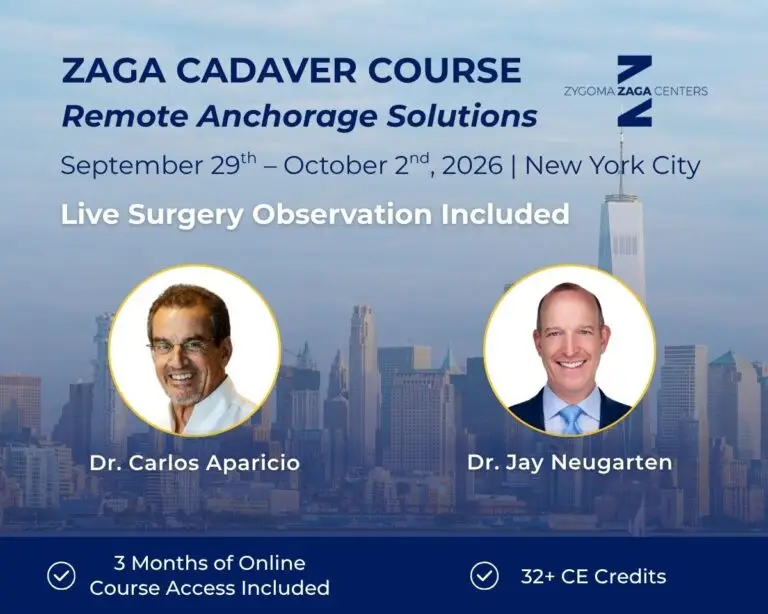
Dr. Jay Neugarten, an oral and maxillofacial surgeon and head of the certified ZAGA Center New York, describes a nearly three-decade evolution in treating the severely atrophic maxilla. Between 2001 and 2007 his edentulous care centered on autogenous bone grafting from the tibia or hip; from 2007 onward zygomatic implants steadily replaced grafting as success rates approached the high 90s, with his group reporting 98% efficacy. He attributes a logarithmic improvement to combining the ZAGA concept of anatomy-guided surgical placement with Carlos Aparicio's 2021 implant design, which offers a flat, non-fully-threaded body, thin apices, varied lengths and prosthetic options, reducing palatal placement, speech and hygiene issues, swelling and soft-tissue retraction. Neugarten frames zygomatic implants as a single-surgery frontline solution, stresses empathy, restorative collaboration and telemedicine planning, and advocates mentorship, previewing a September 2022 ZAGA Course in New York with Aparicio.
Key takeaways
- Zygomatic implants were introduced in the United States in 1997, building on the 1987 vision of Per-Ingvar Branemark and Carlos Aparicio.
- From 2001 to 2007 Dr. Neugarten's edentulous rehabilitation relied on bone grafting from the tibia or hip; after 2007 zygomatic implants progressively replaced grafting in his practice.
- Dr. Neugarten's group reported 98% efficacy for their zygomatic implant solutions and states a second paper is forthcoming.
- The zygoma bone does not undergo atrophy like the maxilla, so bypassing the resorbing upper jaw into the zygoma provides durable support for full-arch rehabilitation.
- Carlos Aparicio's zygomatic implant, released in 2021, has a flat side, is not threaded to the top, and has thin apices, giving robust integration, primary stability and more prosthetic and length options.
- In Dr. Neugarten's workflow the same-day provisional prosthesis is screw-retained acrylic with a cleared palate, and the restorative dentist delivers it at his single ZAGA Center rather than sending patients elsewhere.
- Post-operative recovery typically uses Tylenol, Advil and sinus medication with only a low-level narcotic rather than oxycodone, Vicodin or Percocet.
- Dr. Neugarten treated patients across a wide age range, including a 90-year-old patient named Peggy, indicating the solution is not age-exclusive.
What you'll learn
- Why zygomatic implants can be a frontline rather than last-resort solution for the atrophic maxilla
- How the ZAGA concept and implant design reduce palatal placement, speech and hygiene problems, swelling and soft-tissue retraction
- The prosthetically driven patient journey: CBCT, digital scan, restorative-dentist collaboration and telemedicine planning
- Why the zygoma bone resists atrophy unlike the maxilla, and why that makes the approach durable
- Post-operative recovery, provisional versus final prosthesis, and managing patient fear and comorbidities
- The value of mentorship and hands-on courses over weekend training for building competence and managing complications
About the guest
Dr. Jay Neugarten
Dr. Jay Neugarten is an oral and maxillofacial surgeon practicing in Manhattan, New York, as part of a group focused on tertiary care in the private-practice setting, from single implants to quad zygomatic reconstruction, orthognathic and TMJ surgery. His practice, the New York Center for Orthognathic and Maxillofacial Surgery, is the certified exclusive ZAGA Center New York. He has worked with zygomatic implants for over 20 years and serves as a ZAGA mentor, co-organizing ZAGA courses in New York with Dr. Carlos Aparicio.
Credentials: Oral and Maxillofacial Surgeon (DDS, MD, FACS); certified ZAGA Center New York (New York Center for Orthognathic and Maxillofacial Surgery); ZAGA mentor